
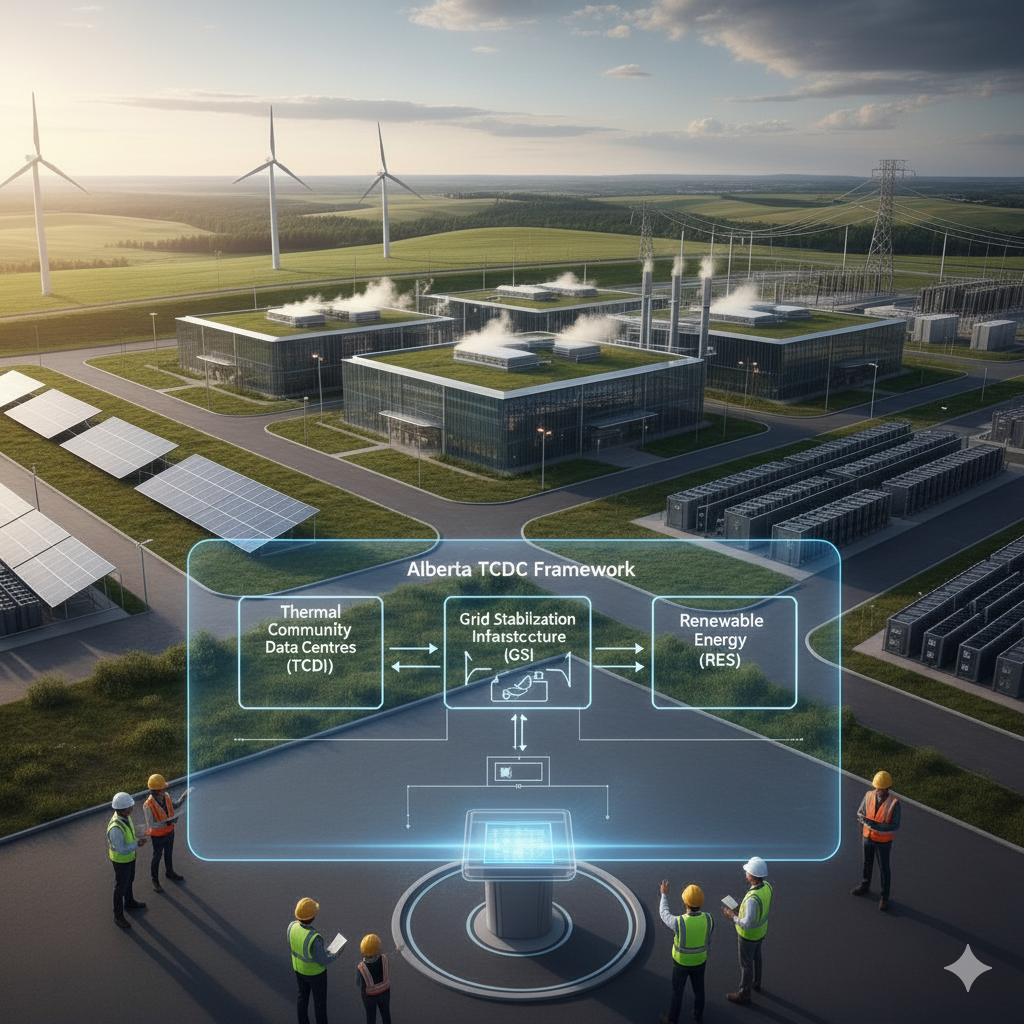
Reframing Data Centres for Grid Stability: Alberta’s TCDC Framework and Engineering Implications
The rise of hyperscale data centres has transformed them from IT utilities into vital nodes of the modern power system. In Alberta, this transformation is reshaping how energy infrastructure is planned and operated. The Alberta Electric System Operator (AESO) has introduced the Transmission-Connected Data Centre (TCDC) Framework, a landmark regulation that positions data centres as active participants in maintaining grid stability rather than passive power consumers.
1. Why Alberta Needed the TCDC Framework
Alberta’s grid—small and weakly interconnected compared to systems like PJM or ERCOT—faces growing reliability risks. Between 2024 and 2025, AESO received 29 connection applications totaling over 16,000 MW of data-centre demand, exceeding the province’s total winter peak of 12.4 GW. Such scale meant traditional load rules were no longer sufficient. The new TCDC requirements redefine how large digital loads connect to and interact with the grid.
“Data centres must now behave like grid-supportive assets—capable of ramp control, ride-through, reactive support, and telemetry.” —AESO, 2025 Draft TCDC
2. Key Technical Requirements
- 01Ramping control: Active power intake limited to ≤10 MW/min to prevent frequency shocks from AI or cloud workloads.
- 02Fault ride-through: Facilities must remain connected through deep voltage sags (to 45%) and low-frequency events (down to 57 Hz).
- 03Reactive power support: Maintain ±0.95 power factor with sub-second VAR response to stabilize local voltage.
- 04Harmonic & oscillation control: Variability capped at 16 kW/100 ms; harmonics must be measured, reported, and mitigated.
- 05SCADA & telemetry: Dual communication paths for ≥300 MW sites and validated EMT/phasor models for grid simulation.
- 06Load shedding: Centres must curtail non-critical compute blocks on AESO command.

3. Design and Operational Implications
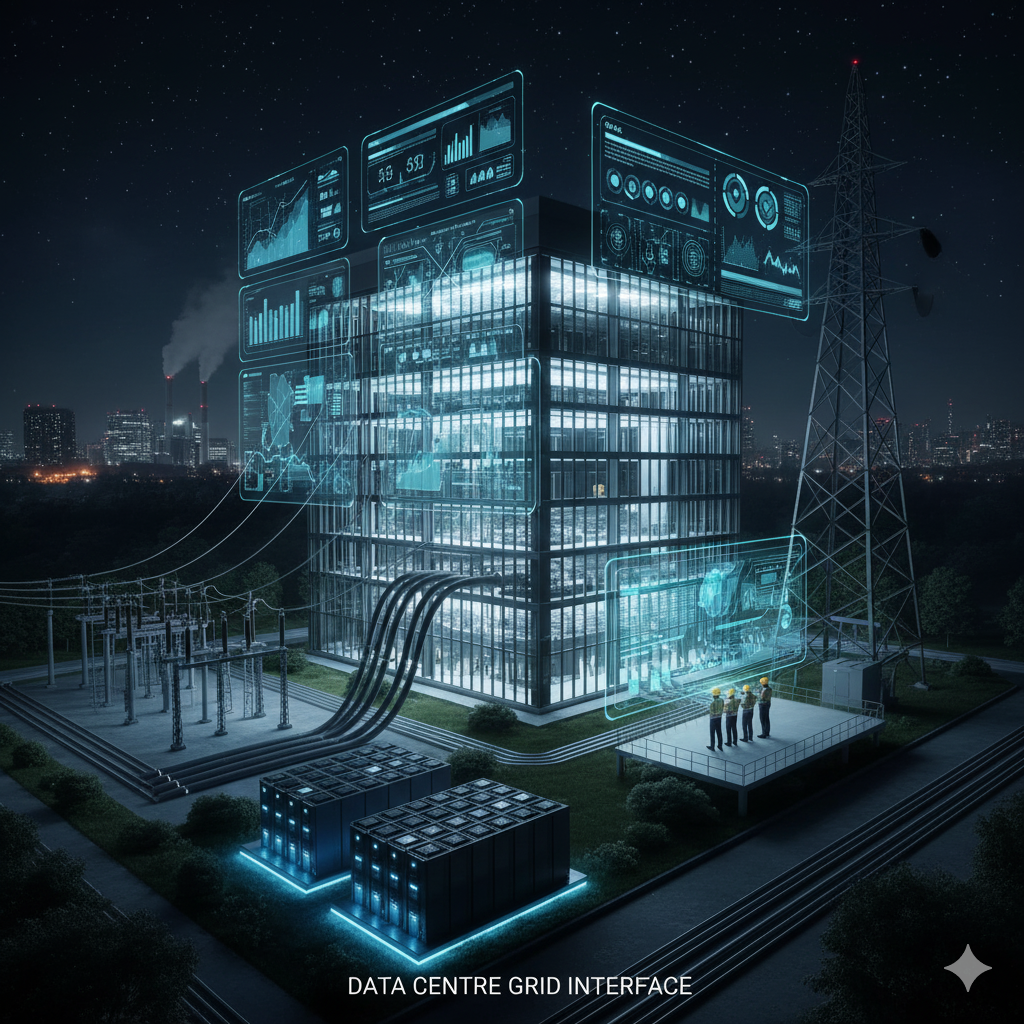
Meeting TCDC obligations requires re-engineering traditional data-centre infrastructure. UPS, battery, and power-conversion systems must evolve from backup devices into active grid interfaces capable of ramp smoothing, VAR control, and harmonic mitigation. Integration with Energy Management Systems (EMS) and SCADA ensures visibility and control. IT workload orchestration tools, such as Kubernetes, must link compute demand with power availability to enable load shedding without service loss.
4. Smart Grid Analytics’ Role
Smart Grid Analytics (SGA) supports compliance through end-to-end engineering—covering PSS®E and PSCAD modelling, digital-twin analytics, and EMS integration. Drawing from its proven Microgrid Project in Saudi Arabia, SGA provides validated models, ramp-limit controls, and harmonic monitoring systems that align with AESO’s “proof-not-paper” approach. Its solutions bridge the traditional divide between IT developers and power engineers.
5. Conclusion & Recommendations
Alberta’s TCDC framework marks a paradigm shift: data centres are now grid actors responsible for stability, not just uptime. Developers must adopt validated models, grid-aware EMS systems, and operational analytics to ensure continuous compliance. For Alberta, this proactive regulation not only safeguards reliability but positions the province at the forefront of integrating programmable digital demand into a resilient energy future.

Unlocking India’s Renewable Grid: Policy-Driven Solutions to CON4 Delay
India’s renewable energy transition is among the most ambitious in the world—targeting 500 GW of non-fossil capacity by 2030. Yet, achieving this target hinges on a critical process known as Connection Agreement Stage 4 (CON4). Recent policy and technical delays in CON4 approvals have slowed the commissioning of renewable and hybrid projects, especially in RE-rich states like Gujarat, Rajasthan, and Karnataka.
1. Understanding the CON4 Bottleneck
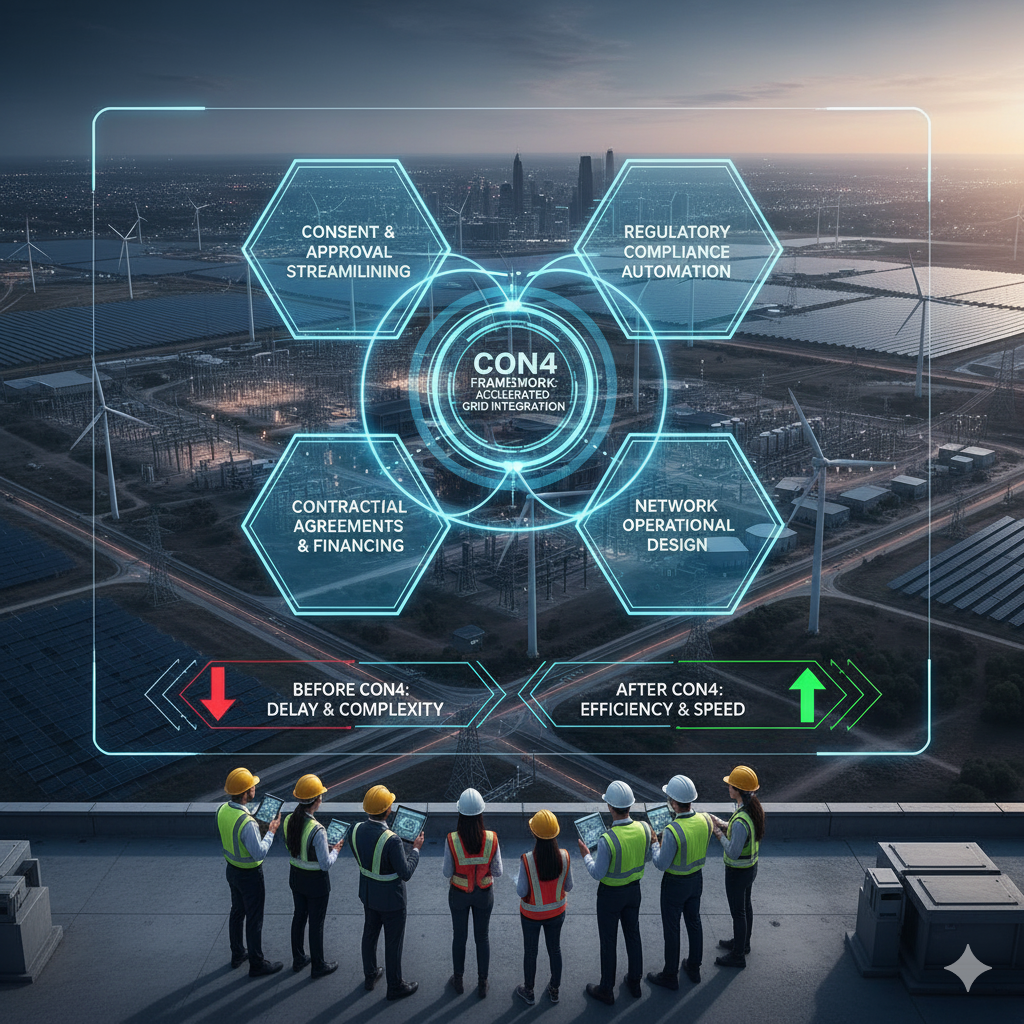
Under India’s transmission framework, the CON4 stage defines the final technical and commercial readiness for grid interconnection. As of late 2024, over 25 GW of solar and wind capacity was stranded due to procedural delays in CON4 approval and grid synchronization. These delays stem from constraints in reactive power compensation design, load-flow studies, and communication readiness—areas that require coordinated planning between renewable developers, CTU, and RLDCs.
“The renewable transition is not just about adding megawatts, but synchronizing digital, electrical, and policy systems to operate as one grid.” —Kumar M
2. Policy Reforms: A Structured Response
The Ministry of Power (MoP) and Central Transmission Utility (CTU) introduced a new Renewable Energy Grid Interconnection Procedure (REGIP) in 2025 to streamline CON4 timelines. The framework sets 90-day approval targets, mandates concurrent load-flow validation, and enforces digital model submission in PSSE and PSCAD formats. Renewable developers are now responsible for validated data, reducing the burden on CTU and accelerating project clearances.
- 01Parallel CON4 processing with technical model submission.
- 02Reactive compensation standardization using ±0.9 power factor benchmarks.
- 03Digital dashboards for transparency and milestone tracking.
- 04Hybrid grid testing using AI-driven digital twins.

3. Engineering and Grid Integration Challenges
The shift from conventional load-flow studies to hybrid grid simulation has exposed gaps in data consistency, reactive design margins, and inverter-grid coordination. Renewable developers often rely on vendor-provided models that fail to meet CTU validation. Under the new process, developers must provide validated PSCAD, EMT, and RMS models that replicate real fault and ramp responses within 2% of measured values.
This is a major engineering shift. EPC firms now need teams skilled in simulation, grid studies, and control tuning—bridging the divide between project engineering and power system analytics.
4. Smart Grid Analytics’ Role
Smart Grid Analytics (SGA) provides technical support for CON4 compliance through model validation, dynamic simulation, and hybrid grid studies. Leveraging its expertise from Alberta’s TCDC and GCC interconnection projects, SGA’s digital twin and cloud-based model verification tools help developers achieve “proof-ready” documentation. The firm also assists DISCOMs and CTU in creating automated screening tools that pre-validate project data before submission.
5. Conclusion: Towards a Predictable Renewable Future
Unlocking India’s renewable potential depends on reducing uncertainty in the final connection stages. The REGIP and CON4 reforms are a decisive step in that direction—integrating engineering, digital, and policy systems. By combining structured procedures with tools like Smart Grid Analytics’ simulation and validation frameworks, India is positioning itself to not only meet but exceed its 2030 renewable energy vision.

Smart EMS for Smart Data Centres: Reinventing Backup Infrastructure for the Digital Era
As data centres evolve into the backbone of global digital infrastructure, their power systems must advance beyond legacy backup models. Conventional UPS + DG setups are no longer sufficient to meet ESG mandates, grid-interactive requirements, or the zero-downtime demands of AI and cloud computing. The Smart Energy Management System (Smart EMS) introduced by Smart Grid Analytics (SGA) redefines how data centres manage, store, and dispatch energy.
1. Challenges with Legacy Backup Systems
Traditional data centre backup architectures depend on diesel generators (DGs) and UPS systems for emergency power. While reliable, these systems face increasing scrutiny due to their carbon intensity, fuel logistics, and slow recovery times. Environmental, financial, and real-time performance requirements are driving operators to seek cleaner, faster, and more intelligent alternatives.
The Smart EMS replaces static backup systems with dynamic control layers integrating Battery Energy Storage Systems (BESS), Power Conversion Systems (PCS), and predictive dispatch algorithms—creating a responsive, fuel-free backup framework.
“EMS + PCS + BESS is not a replacement for the diesel generator—it’s the next evolutionary step toward intelligent, carbon-neutral data centres.” —Kumar M
2. The MG Project – Proof of Concept
The Smart EMS was validated through the Microgrid (MG) Project in the Kingdom of Saudi Arabia—a large-scale deployment integrating PV arrays, BESS, ICEs, and multi-zone SCADA control. The project achieved 100% EMS availability, 25–30% fuel reduction, and millisecond response times in autonomous (islanded) mode.
SGA’s controller platform managed predictive scheduling, island-mode control, SOC balancing, and frequency regulation, ensuring seamless transitions between grid-connected and off-grid operations.

3. Smart EMS Architecture for Data Centres
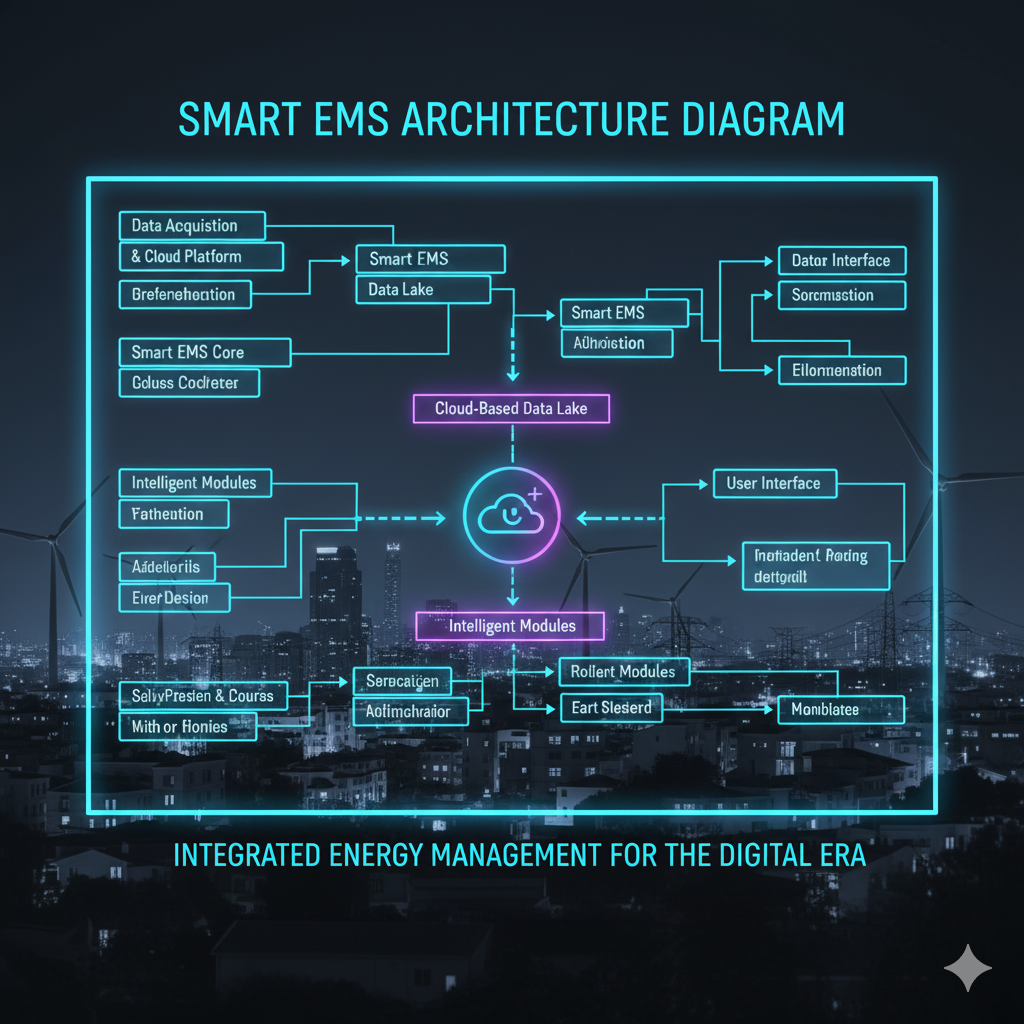
The Smart EMS integrates physical, control, and communication layers into a unified digital backbone. It uses IEC 61850 and Modbus TCP/IP for interoperability and AI-based forecasting for predictive scheduling. Core features include:
- 01Multi-Mode Power Control: Operates seamlessly in grid, island, or black-start modes.
- 02VSG Inertia Simulation: Stabilizes frequency and voltage during disturbances.
- 03Predictive SOC Management: Optimizes battery state-of-charge based on load and HVAC patterns.
- 04Real-Time Load Prioritization: Protects mission-critical racks and cooling systems first.
- 05Cyber-Secure SCADA: Provides encrypted, role-based control compliant with IEC 62443.
4. Adaptations for Tier III & IV Data Centres
Modern Tier III/IV facilities demand zero switch-over time, diesel-free operation, and compliance with ISO and ESG frameworks. The Smart EMS achieves this by integrating BESS and PCS parallel to existing UPS systems, enabling:
- 01Instant black start capability via BESS.
- 02Seamless transition between mains, UPS, and BESS.
- 03Rack-level power management driven by SOC and temperature data.
- 04Dynamic load shedding and grid participation readiness.
5. Cybersecurity & Compliance
With cybersecurity now a Tier IV certification requirement, the Smart EMS implements IEC 62443-aligned controls, including: Role-Based Access Control (RBAC), encrypted communication, firewall segregation, and patch management support. These controls ensure both data and operational integrity while meeting global ESG and ISO standards.
6. Conclusion – Future-Ready by Design
The Smart EMS architecture transforms data centres from passive energy consumers into active, intelligent power systems. By integrating renewable generation, battery storage, and predictive analytics, Smart Grid Analytics enables facilities to achieve full resilience with zero-diesel operation.
As workloads become increasingly complex and power-sensitive, Smart EMS represents the next step in sustainable, scalable, and compliant energy orchestration for the digital age.